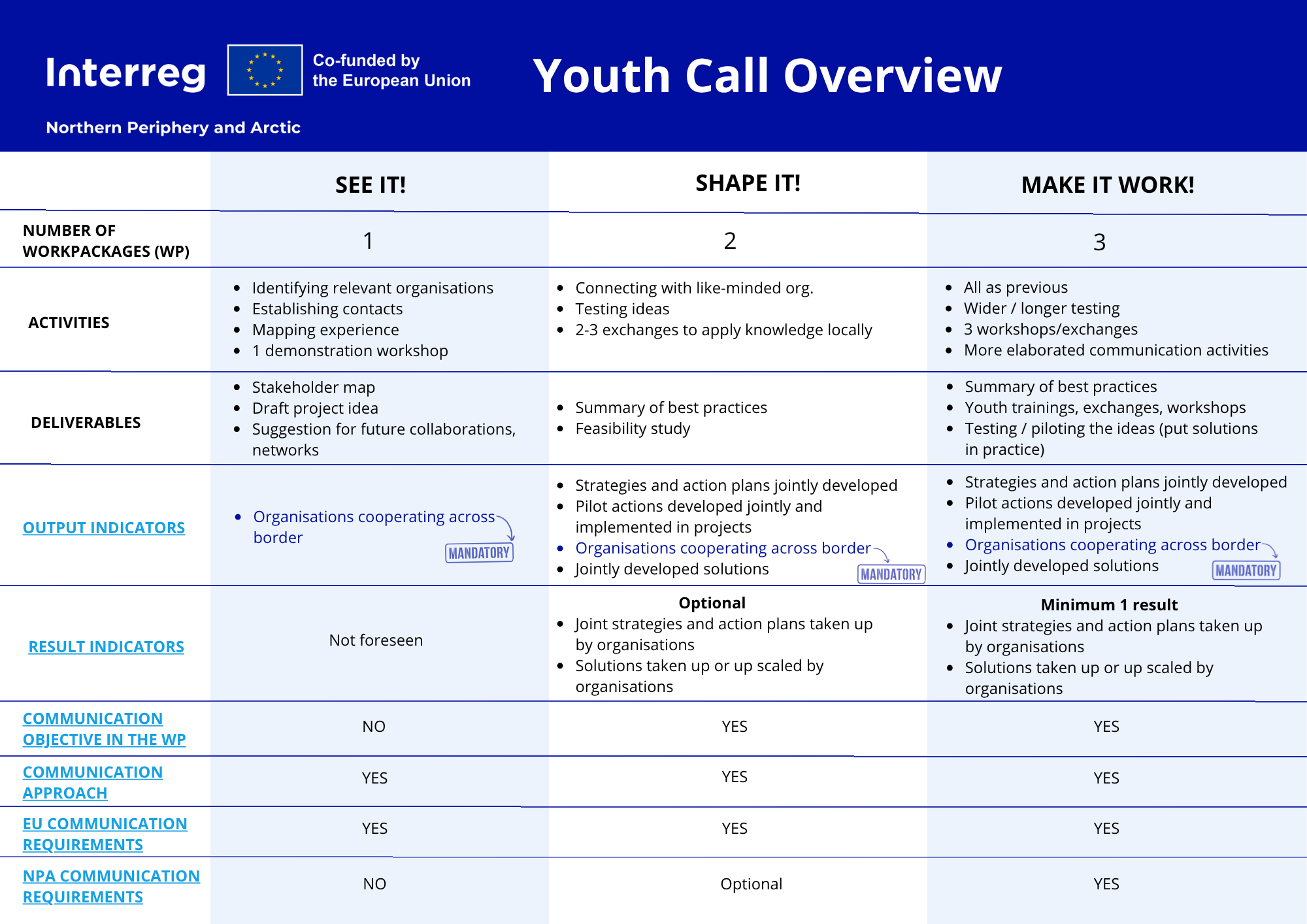
In previous sections it was explained what the different expectations and focus of youth projects are, depending on their type. This section will focus more on explaining what kinds of activities, output, and results are suitable for youth projects and how applicants should develop their workplan. For more information, see also the PDF presentation from the #2 Youth track webinar “Budget, workplan & outreach” and the overview below.
Click to enlarge
First, let’s clarify some terms. Workplan is the list of planned activities and outputs – the work that the partners will be doing. The Workplan is divided into work packages – 1 work package for each 6 months to help applicants organise their activities and match them with payments.
Understanding the results, outputs, activities, and deliverables
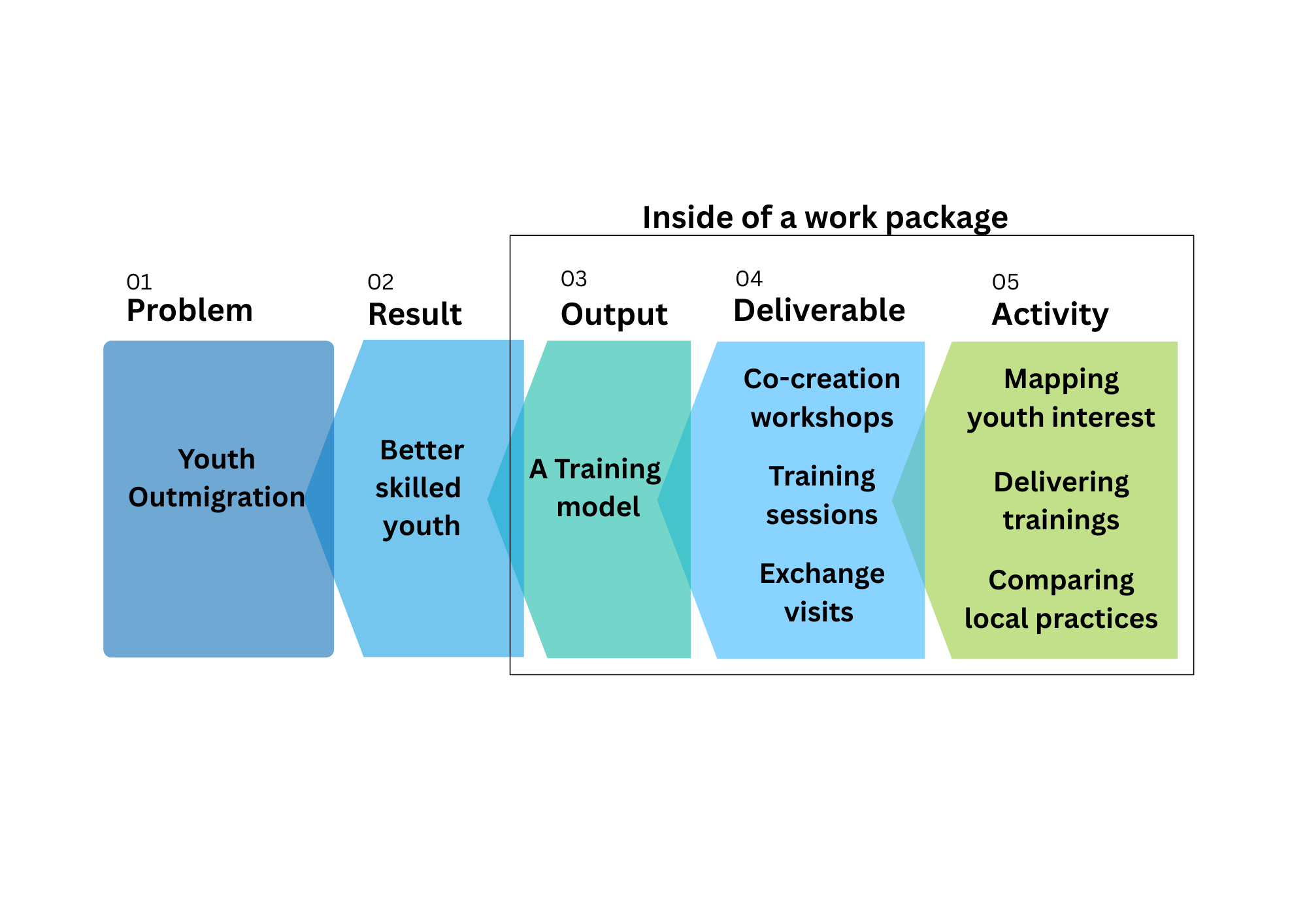
An output is a concrete tool, strategy, action plan, or model that compiles the work of the project in a way that others can adopt it, build on it, or reuse it. When this output is implemented by some organisation in the NPA area, it will bring a positive change to people living there. This positive change – improvement – is what the NPA understands as a result. The results – changes – are seen only once the outputs are used in real life by e.g. organisations, local authorities, SMEs, etc.
Each output is created through a series of smaller events (e.g. workshops, visits, meetings, surveys, etc.) that are called deliverables. Closely linked with deliverables are activities – these are the actions that deliver deliverables – e.g. mapping youth interest (activity) involves 3 co-creation workshops (deliverables) and creates a list of youth interests (deliverable). As a rule of thumb, one could say that activities end with -ing as they are the actions, and deliverables are nouns.
Workplan logic
Your questions
Which activities and deliverables should I produce?
Types of activities and deliverables that the project should achieve depend on the project type and focus. See the section about project types and expectations to understand what each project type focuses on. We have also prepared a Youth Call Overview where you can compare what activities and deliverables are expected from which types of Youth projects.
Which outputs and results should I deliver if I am running a SEE IT! project?
Check out the Youth Call Overview, where the requirements for different Youth projects are listed.
SEE IT! projects will only count the number of partners (incl. the associated partners) in the project and report this as Output “Organisations cooperating across borders”. These projects are not expected to deliver any other outputs, nor results.
Which outputs and results should I deliver if I am running a SHAPE IT! project?
Check out the Youth Call Overview, where the requirements for different Youth projects are listed.
SHAPE IT! projects have different possibilities. At first, they also need to deliver the mandatory Output “Organisations cooperating across borders”. Secondly, they can choose which other outputs fit their focus and types of activities. There is no maximum or minimum number of outputs delivered. It is up to the project team to decide what and how many outputs they can deliver based on their resources. SHAPE IT! projects may choose to deliver a result, but this is not mandatory. It is voluntary for outputs to be implemented by organisations, SMEs, authorities, etc. It is also acceptable if a project does not deliver a result.
Which outputs and results should I deliver if I am running a MAKE IT WORK! project?
Check out the Youth Call Overview, where the requirements for different Youth projects are listed.
MAKE IT WORK! projects are also asked to report on how many partners the project has – this is the mandatory Output “Organisations cooperating across borders”. Secondly, they can also choose which and how many of the other outputs they want to deliver. The selection should reflect their longer duration, higher budget and different focus of activities, e.g. it is expected that these projects will deliver more or longer pilots than SHAPE IT! projects. But again, the final number of outputs is up to the project, there is no maximum or minimum amount.
These projects are required to deliver Results. In their application, they must already indicate whether, and by whom, their outputs will be taken up and used in everyday practice. MAKE IT WORK! projects must include at least one Result.
Are there any mandatory outputs or results?
Yes, there is 1 Output that is mandatory for all youth projects – “Organisations cooperating across borders”. Other outputs and results can be selected as they fit to project’s activities and objectives.
What to count for Output “Organisations cooperating across borders”?
The Output “Organisations cooperating across borders” counts how many partners + associated partners there are in the project. It does not count how many organisations the project has reached with its activities.
What Outputs and Results can projects choose from?
Interreg NPA offers 4 Outputs and 2 Results for projects to choose from.
Outputs:
Strategies and action plans jointly developed
Pilot actions developed jointly and implemented in projects
In Interreg NPA, results are the real changes from your project. You only see these changes when organisations put your outputs into practice.
For example: if your project creates a training model and a business support organisation uses it, young people can learn better skills.
What kind of outputs and results are considered strong?
Before we start talking about outputs and results, we need to clarify these terms.
An Output is a concrete tool, strategy, action plan, or model that compiles the work of the project in a way that others can adopt it, built on it, or reuse it.
Result on the other hand is a change the project brings and that will live after the project ends. Results – changes – are seen when organisations implement outputs (strategies, action plans, solutions, models, etc.) as part of their working practices or services provided. Therefore, the relevant organisations are then using the tools and solutions developed in NPA projects ensuring these are addressing the problem the project has identified at its beginning.
To answer the question: strong outputs are the ones that are taken up and strong results are the ones that change people’s lives.
How many work packages do I need in the project?
That depends on which type of project you are running. Each work package corresponds to 6 months and a youth project phase.
SEE IT! projects – 6 months – 1 work package called SEE IT!
SHAPE IT! projects – 12 months – 2 work packages called SEE IT! & SHAPE IT!
MAKE IT WORK! projects – 18 months – 3 work packages called SEE IT! & SHAPE IT! & MAKE IT WORK!